URBAN/
FREEWAYS
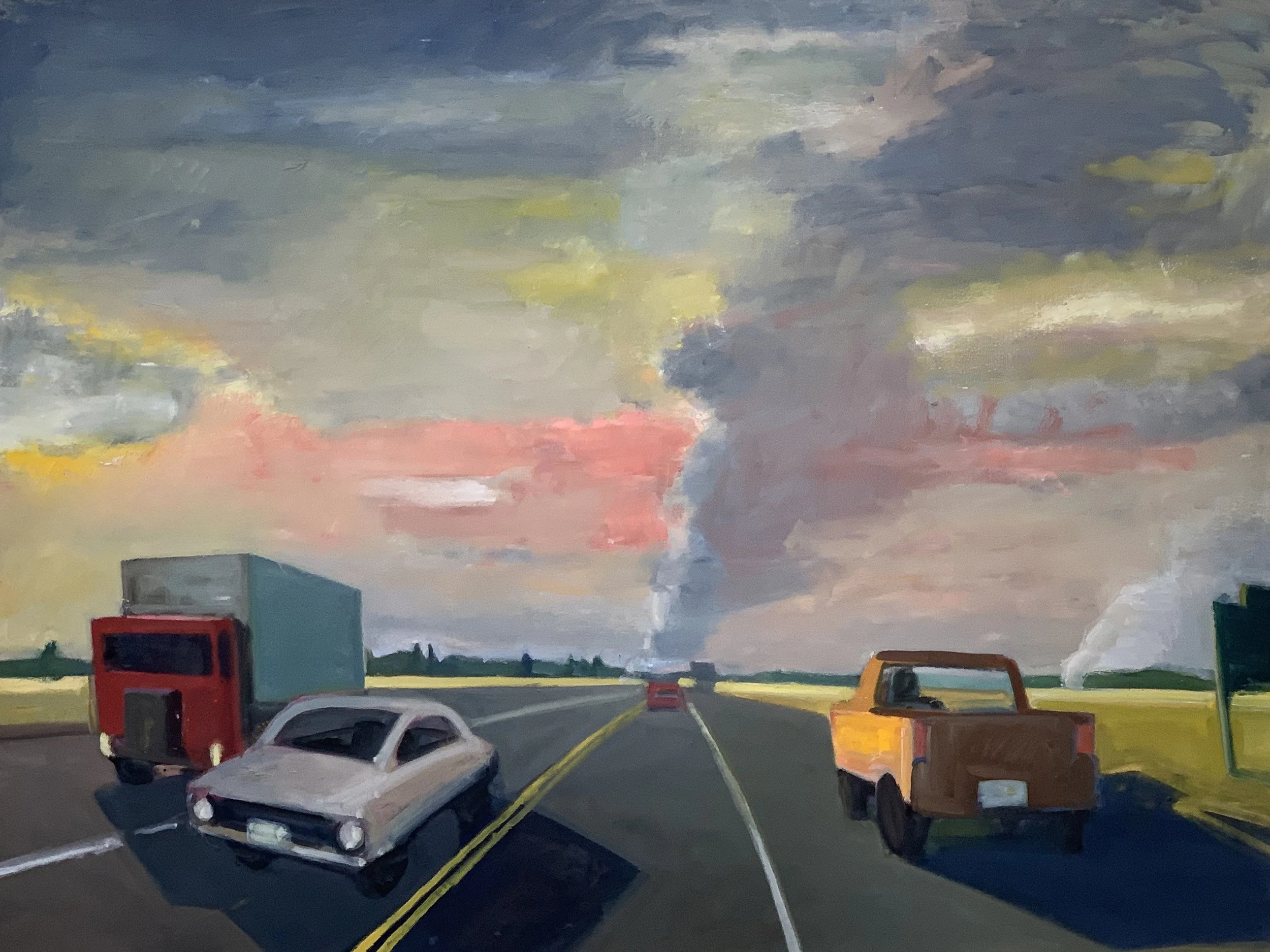
Freeway – Heading South, Leaving S.F., 2023, oil on panel, 25.5 x 68 in.
Freeway – Curve Toward Sixth Street, 2022, oil on panel, 25.5 x 68 in.
Freeway to the Bridge, 2021, oil on board.
View from Studio–Night, 1984, oil on canvas, 56 x 66 in.
Towers, Stacks & Green, 1987, oil and oil stick on paper, 38 x 50 in.
Cranes—Night, 1983, oil and oil stick on canvas, 30 x 40 in.
North Beach View II, 2008, oil on canvas.
Freeway II—Chevron, 1992, acrylic on paper, mounted on canvas, 50 x 38 in.
Freeway—Hamm’s Curve, 1988, oil, oil stick, and enamel on paper, 22.5 x 28.5 in.
Freeway IV–Con/Curve, 1992, charcoal on paper, 27.5 x 39.5 in.
My love of the urban landscape, especially that of San Francisco, moved me onto the freeway—my studio away from home. Having lost a studio that gave me a fixed vantage point on the City, I chose a moving one—my car.
I was interested in the city itself, its hills and valleys that allow fog and sun and shadow to stretch and play with space. I love the changes of scale that can be embraced in an eye's sweep: large buildings that pop up and push against the skyline, cutting through the staccato of smaller, more distant ones. And I love the freeway, the large urban sculpture that laces the city together.
I began drawing and photographing while stuck in traffic jams or moving slowly, or, for a little more ease and safety, with others driving. I ended up with a quantity of notebooks full of rough, speedy drawings. From those initial sketches I worked on several generations of freeway pictures over the course of time, some of which are displayed here.
Though my initial interest was the city, it soon became apparent that what I was drawing was the freeway itself, with the city and its buildings as both background and onlookers to a stage where the cars are actors. The freeway becomes a ribbon of movement bounded by static, yet distorted, buildings. One was now on the freeway and in the midst of speed itself.
A primary focus for my work in the 1970s and 1980s was the industrial landscape which surrounded my former studio in San Francisco. I was particularly drawn to the nearby Bethlehem Steel shipyards. This grey world by day came alive at night as fierce security lighting and arc welder's torches illuminated and drew shapes out of the darkness.
Structure, as it is played upon by light in space, has been a recurring them in my paintings. I am drawn to shapes that arrive in the landscape out of an idea of utility more than one of conventions of aesthetics. It is "the structure of the ordinary", whether objects from the kitchen table or the raw industrial edge of the city, as well as the freeway that laces it together, which holds my attention.
In some of these paintings, I have merged the two worlds — where objects of domesticity are set in the foreground against a cruder, rough-edged, industrial world, the difference being only a matter of scale. It is through the juxtaposition of these two worlds, often from a wide-angled viewpoint, vibrant colors that ricochet around a piece, and the use of light, especially as it emerges out of darkness to reveal hidden shapes, that I attempt to achieve a sense of mood.